
Setting Up a Personal Alarm Before Coming Home from Hospital
Arranging a personal alarm after hospital discharge can give someone a way to request help at home. The useful work starts before the journey home: choosing the right connection, agreeing contacts and making sure the person knows how to use the alarm.

Start with the hospital’s discharge plan
Ask the team what support is needed and discuss where an alarm might fit. The NHS guide to planning to leave hospital explains that equipment, ongoing care and practical arrangements should be discussed before discharge. Local arrangements and services vary, so use your own hospital team as the point of contact.
Keep the person returning home involved. Ask what would help them feel comfortable, what they can manage independently and whether a relative can help with setup. Do not assume an alarm resolves concerns about supervision, mobility or personal care.
Choose a connection that is available at the property
Find out whether there is working broadband at home. A digital home alarm connects through broadband. A GSM home alarm uses the mobile network through its base unit and needs suitable reception.
If the person will be staying temporarily with family, give the provider the address where the alarm will actually be used. Ask what needs updating if they later return to their own home. Do not assume moving the equipment leaves the monitoring records or connection arrangements correct.
6 checks for a personal alarm after hospital discharge
| Task | What to confirm |
|---|---|
| Equipment | The chosen device, accessories and connection meet the person’s intended use. |
| Timing | Delivery, setup and activation arrangements are confirmed with the supplier. |
| Contacts | Nominated people know they are listed and have provided current numbers. |
| Access | There is an agreed way to enter if the user cannot open the door. |
| Testing | The alarm is connected and a test is completed according to the instructions. |
| Daily use | The wearer understands the button and any charging routine. |
Make wearing and pressing the button straightforward
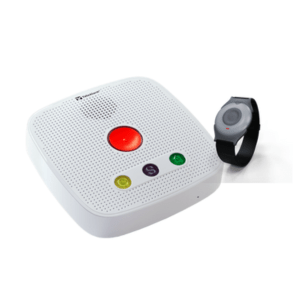
Think about how the person will use the alarm while sitting, resting or moving around the home. Can they find the button and press it comfortably? Does a wristband or neck pendant suit them better?
If using a rechargeable device, agree where it will be charged and who can help if needed. Put the instructions somewhere accessible. Family members should understand the routine too, but the person wearing the alarm should have a chance to practise wherever possible.
Consider automatic detection individually
Someone concerned about being unable to press after a fall may wish to discuss a compatible automatic fall detector. That is a separate choice from ordering a standard manual button.
No detector recognises every fall. The user should press the manual SOS when help is needed and they can do so. An alarm cannot prevent falls or replace the discharge team’s assessment of support needs.
Agree the response and home-access arrangements
Check who receives an activation and what information the monitoring service needs. Ask nominated relatives or keyholders about daytime and overnight availability. Someone who is nearby during a hospital visit may have a different routine once ordinary work and family commitments resume.
Consider a suitable key safe or another agreed access arrangement if the person might be unable to reach the door. Share access details through the provider’s agreed process. Keep them off public notes and update them when they change.
What if discharge is soon?
Contact TASK Connect with the anticipated date and installation address. Ask which options can be supplied and what information is still needed. Confirm timing directly rather than relying on a general delivery statement when planning an urgent return home.
If an alarm cannot be ready in time, discuss the situation with the discharge team. Do not treat an unconnected device, an incomplete order or an assumed delivery date as a working support arrangement.
Review the personal alarm after hospital discharge
Needs and routines can change during recovery. Check whether the wearing position is comfortable, contacts are still available and the alarm covers the places the person now uses. Tell the provider about relevant changes instead of assuming the original information remains accurate.
For a broader household checklist, read choosing an alarm for someone living alone and our guide to alarm costs.